Oracy - Voice 21
‘We believe that EVERY VOICE MUST BE HEARD’
Oracy at Blowers Green Primary School
At Blowers Green Primary School, oracy is about helping children develop the confidence and skills they need to speak and listen effectively. It includes how pupils express their ideas, listen carefully to others, and use talk to explore, understand and make sense of the world around them. In the same way that reading and writing develop literacy, and maths develops numeracy, oracy builds confident speakers and thoughtful listeners.
We believe that oracy is a crucial life skill. Strong speaking and listening enable children to form positive relationships, share ideas, ask questions, solve problems and explain their thinking. Through discussion, performance and presentation, pupils learn to communicate clearly and respectfully. Effective oracy underpins learning across the curriculum and supports children to grow into articulate, confident and considerate communicators.
Across the school, we use a child‑friendly version of the Voice 21 Oracy Framework to support the development of these skills. This helps children understand the different aspects of oracy and talk about their progress using clear, age‑appropriate language. As pupils move through Blowers Green Primary, their oracy skills are developed step by step: early foundations are built upon, new strategies are introduced, and vocabulary becomes increasingly ambitious and subject‑specific.
The framework supports children to speak with confidence, clarity and purpose, enabling them to communicate effectively in discussions, presentations, performances and everyday interactions.
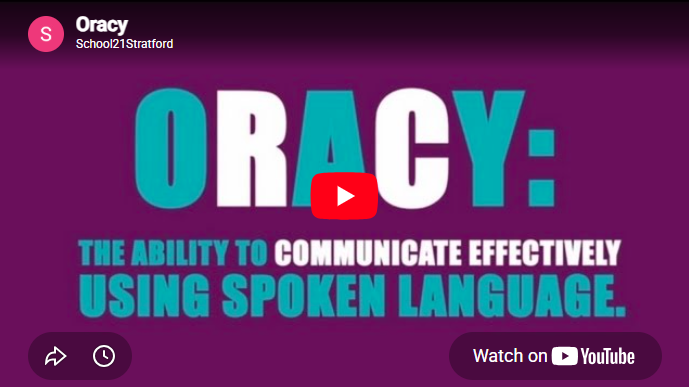
To find out more about what oracy looks like in action, you can watch this short video created by Voice 21.
Click on the image below to view the video.
The Oracy Framework
EYFS Oracy Framework
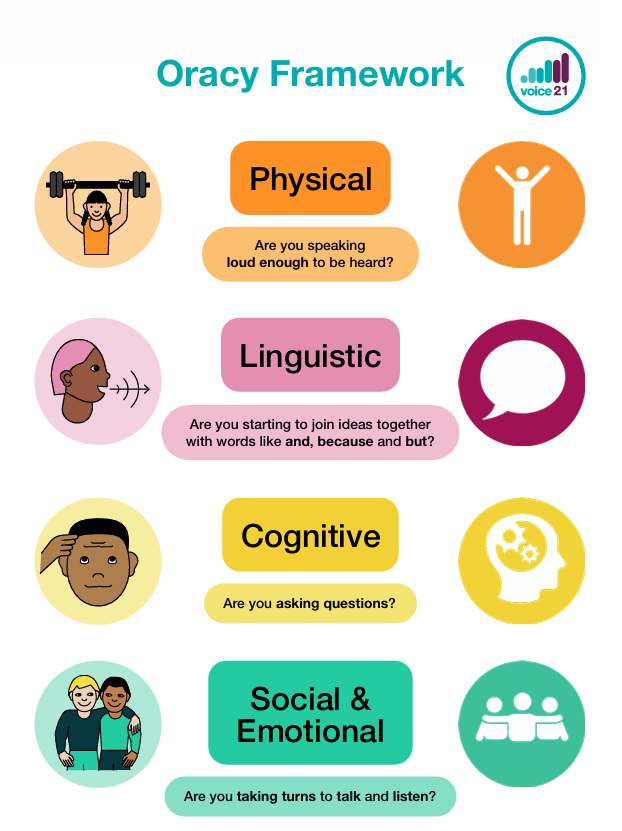
KS1 Oracy Framework
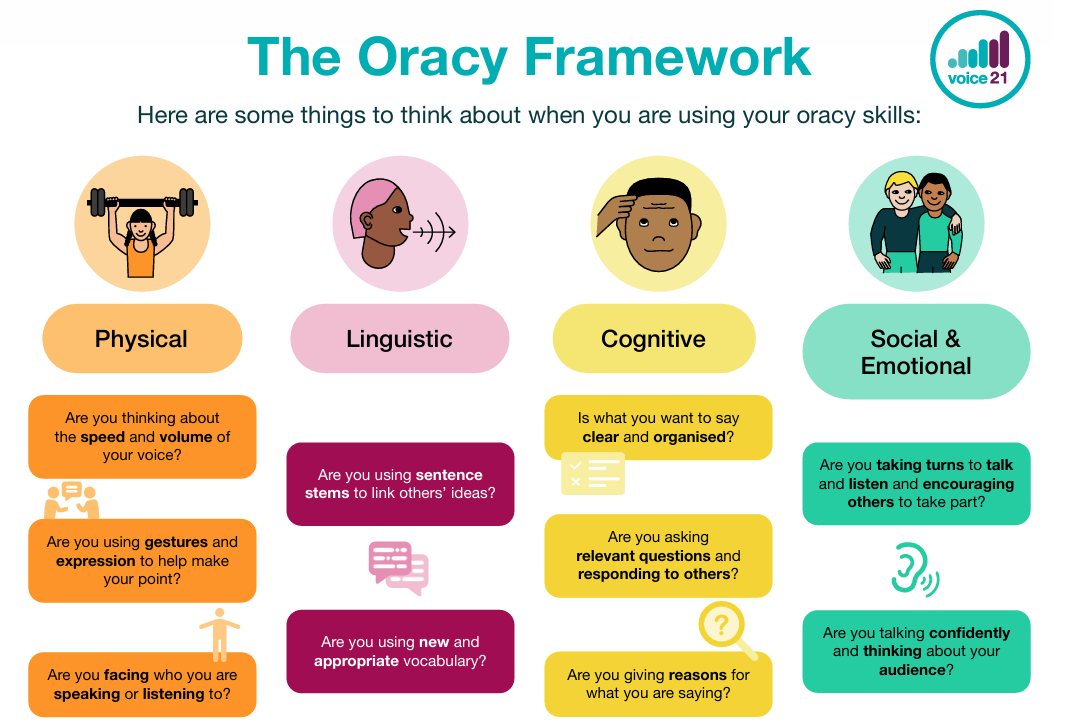
KS2 Oracy Framework
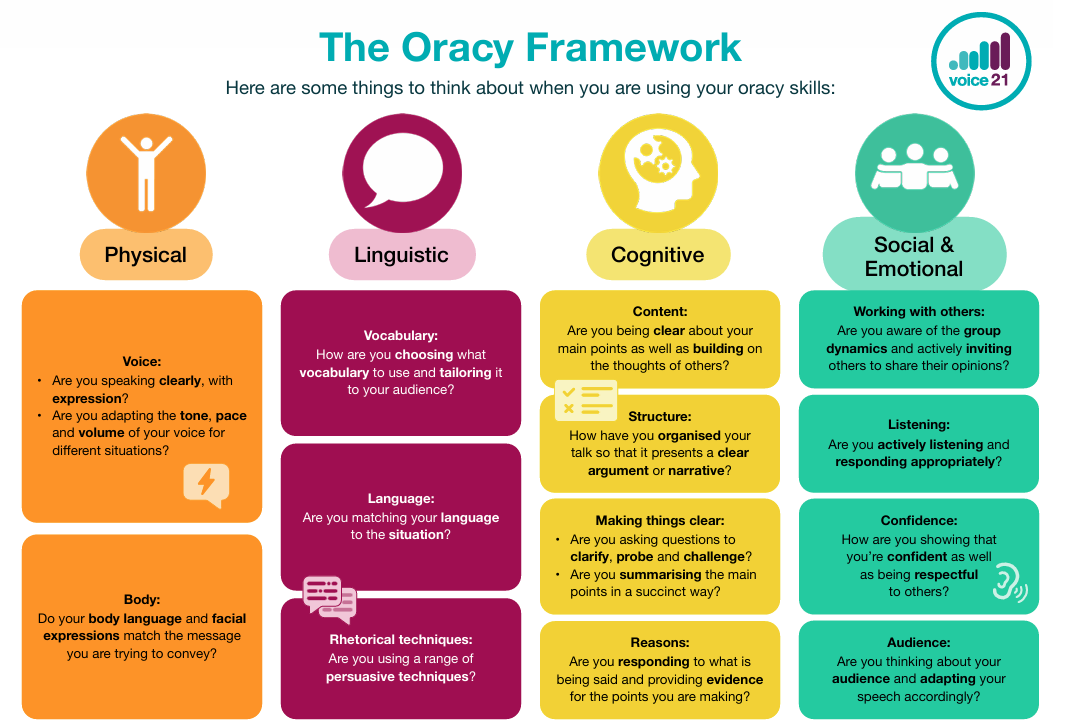
Intent
All children deserve to have their voice heard. At Blowers Green Primary School, we recognise the essential role that oracy plays in children’s academic achievement, social development and emotional wellbeing. Our aim is to ensure that every child can speak clearly, confidently and expressively, enabling them to communicate their ideas and feelings effectively, listen attentively, and respond thoughtfully to others.
We believe that strong oracy skills empower children to build positive relationships, share opinions, solve problems, ask questions, explain their thinking and engage fully in discussions and performances. These skills support learning across the whole curriculum and help children develop into articulate, respectful and self‑assured communicators.
Across all subjects, pupils are provided with rich and purposeful opportunities to develop their spoken language through discussion, drama, role play and meaningful talk. In the Early Years Foundation Stage, Communication and Language is a prime area of learning. Activities are carefully planned in line with the Early Years Foundation Stage Profile and Development Matters guidance, ensuring children experience a language‑rich environment. This includes stories, songs, poems, hands‑on exploration and high‑quality interactions with adults, all of which support strong foundations in oracy.
Implementation
At Blowers Green Primary School, oracy is taught explicitly and embedded throughout the curriculum. We use the Voice 21 Oracy Framework to structure our teaching and ensure clear progression across the four key strands: Physical, Linguistic, Cognitive, and Social & Emotional. Teachers plan purposeful opportunities for talk in every subject so that speaking and listening are central to learning, rather than an added extra.
High‑quality modelling is a key part of our approach. Staff consistently model clear speech, rich and ambitious vocabulary, active listening and respectful dialogue. Sentence stems, talk frames and visual supports are used to help children organise their ideas and build confidence when speaking. Across the school, pupils regularly take part in a wide range of talk‑rich activities, including:
- Partner talk
- Group discussion
- Questioning, reasoning and problem‑solving activities
In the Early Years Foundation Stage, oracy is embedded within daily routines and continuous provision. Children learn in a language‑rich environment filled with stories, songs, rhymes and high‑quality adult interactions, alongside carefully planned opportunities to develop vocabulary and communication skills.
As children progress through the school, expectations increase in line with our Oracy Progression Map. Pupils learn how to articulate their ideas clearly, listen actively, build on the contributions of others, challenge ideas respectfully, and adapt their talk for different audiences and purposes.
We also promote and celebrate oracy through whole‑school opportunities such as assemblies, performances, themed days and speaking to wider audiences. These experiences help children value their voice and take pride in their communication skills.
Impact
Our approach to oracy ensures that children leave Blowers Green Primary School as confident, articulate and thoughtful communicators. Pupils are able to express themselves clearly, listen respectfully, work collaboratively and use talk to deepen their understanding across the curriculum.
The impact of our oracy provision can be seen through:
- Increased confidence and self‑esteem in speaking situations
- Stronger vocabulary and language development, particularly for disadvantaged pupils and those with SEND
- Higher levels of engagement and participation in lessons
- Improved reasoning, problem‑solving and critical thinking skills
- Enhanced social skills, including turn‑taking, empathy and respectful dialogue
- High‑quality presentations, performances and discussions across the school
Teachers assess oracy on an ongoing basis through observation, questioning, discussion and the use of our Oracy Progression Map. In the Early Years Foundation Stage, Communication and Language outcomes are tracked using the EYFS Profile and Development Matters guidance. Across the school, pupils are encouraged to reflect on their own speaking and listening skills and identify next steps for improvement.
By the time they leave Year 6, pupils at Blowers Green Primary School are equipped with the communication skills they need for secondary school and beyond — able to speak with clarity, listen with respect, and use their voice with confidence and purpose.
How We Teach Oracy at Blowers Green
At Blowers Green Primary School, oracy is taught in a range of ways to ensure children develop a deep and flexible understanding of how talk works. Across the school, pupils take part in a wide variety of structured speaking and listening activities, including:
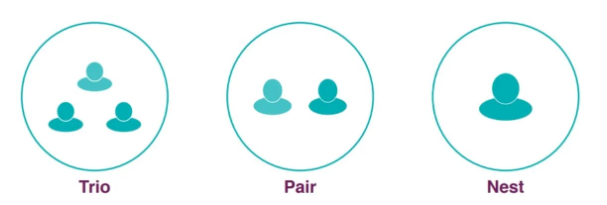
- Paired talk
- Group discussion
- Questioning, reasoning and problem‑solving activities
Teachers plan lessons with oracy at the forefront, ensuring that all children are supported to develop their speaking and listening skills. Learning is carefully structured so that pupils can practise talk in meaningful contexts, build confidence over time, and learn how to communicate effectively for different purposes.
To support this, teachers use a range of effective strategies, including:
- Sentence stems to scaffold talk and support children in expressing ideas clearly
- Talk tactics to promote turn‑taking, purposeful questioning, building on others’ ideas and exploring different viewpoints
- High‑quality modelling of spoken language, active listening and respectful dialogue
- Visual prompts and vocabulary supports to help children organise, extend and refine their talk
Through these approaches, children learn not only what to say, but how to say it — developing clarity, confidence and purpose in their communication.
Poetry By Heart 2025
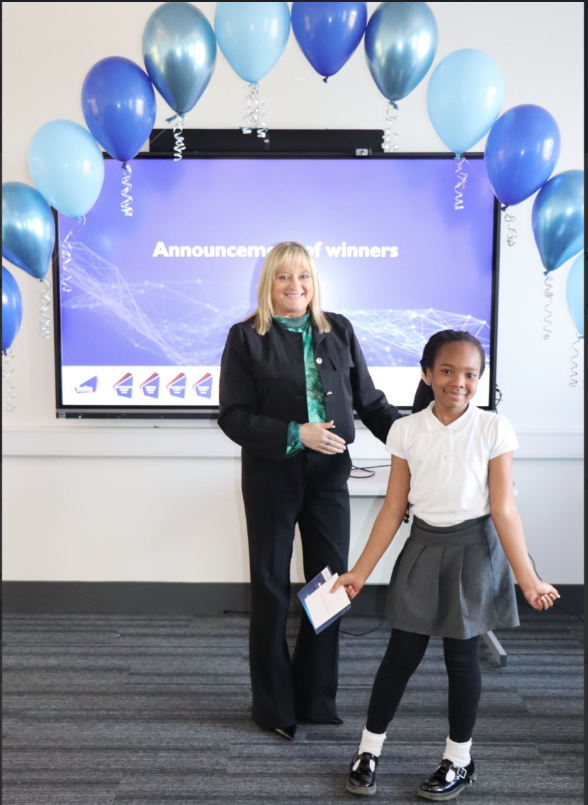
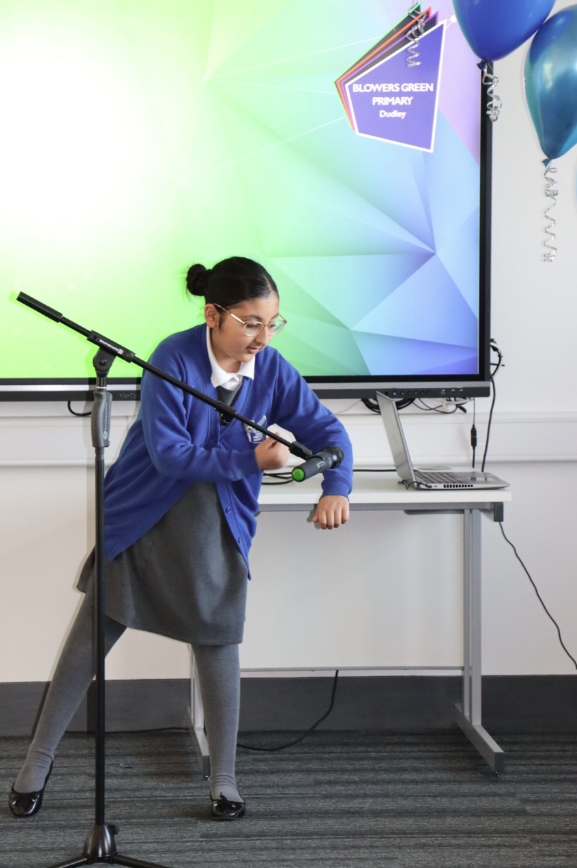
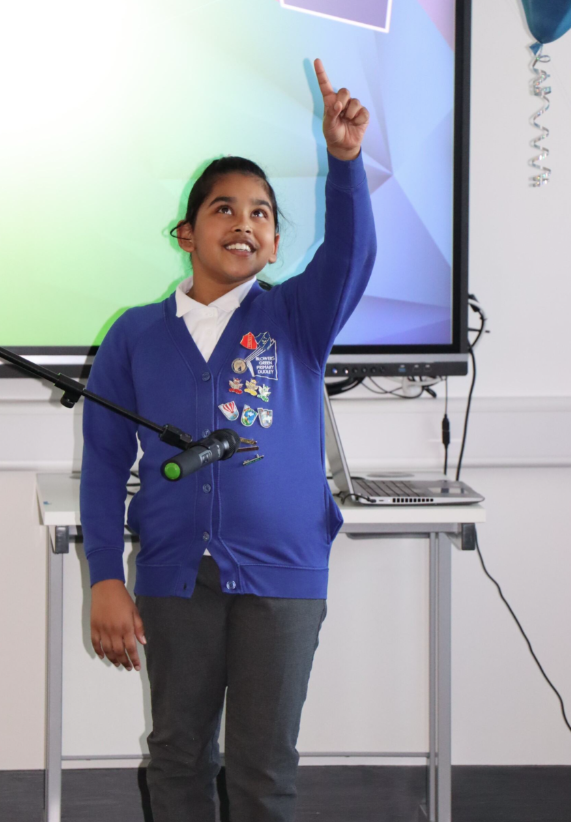
Ten enthusiastic learners from Years 4 and 5 proudly took part in the Trust’s annual Poetry By Heart competition, held at the Institute of Technology. Each participant memorised and confidently performed two poems in front of an audience made up of their peers and families, showcasing not only their growing public speaking skills but also a deepening appreciation for the rhythm and power of language.
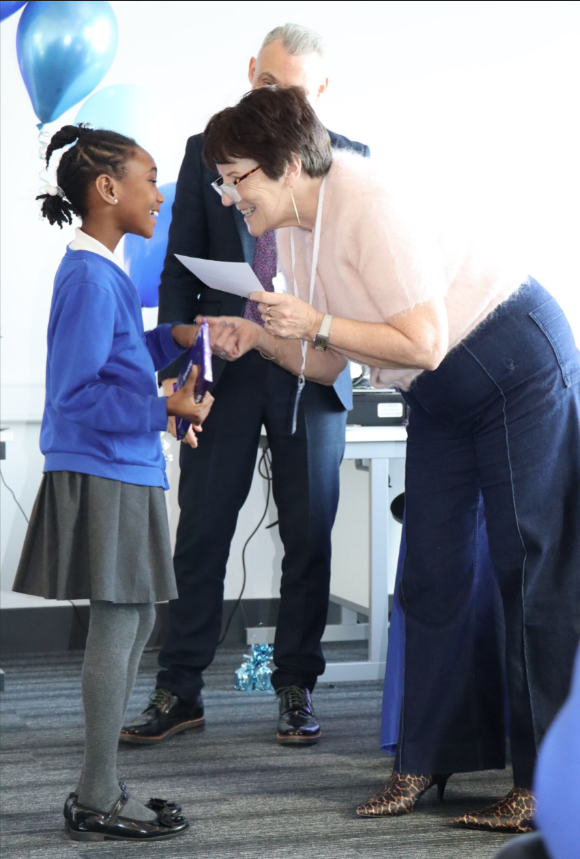
Poetry By Heart offers young learners a valuable opportunity to build confidence, develop memory and oral fluency, and connect emotionally with the written word. Through performance, pupils also enhance their ability to interpret meaning, use expression, and engage an audience—skills that support both academic growth and personal development. Events like this foster a love for literature and create lasting memories of creative achievement.